Showing posts with label femininity. Show all posts

Wednesday, April 10, 2019

The New Woman


The New Woman

The idea of moving into an unknown path sometimes at accelerating rates, can be uncomfortable. The "New Woman" is a part of this. This feminist construct was a new and scary idea being introduced in the 19th century. Sexual openness and aggressiveness had not been seen from the female perspective, nor was it typically appropriate for women to be shown in this light. Stoker brings forth an aggressive view of the Victorian woman. The idea that our "Angel in the House" is now, for a lack of better words, the "Devil in the Streets". We see these ideas are best depicted through the female vampires, Lucy, and Mina. 

Jonathan Harker, fears the female vampires more than the Count. Upon seeing these three female vampires for the first time, Harker mentions in fear, "All three had brilliant white teeth that shone like pearls against the ruby of their voluptuous lips. There was something about them that made me uneasy, some longing and at the same time some deadly fear. I felt in my heart a wicked, burning desire that they would kiss me with those red lips." Like the Victorian New Woman, these female monsters are perverse, unnatural, and horrifying, as they neglect to conform to what traditional Victorian society expects of its women.
Stoker focuses on Lucy and Mina to set the stage for this idea in the idea that the New Woman exists in both of them, but contain different meanings. In Lucy's vampirized state, she no longer suppresses her desire, rather it fully takes affect when she takes multiple blood transfusions from different men, and request that they kiss her on different occasions. Further, she preys on a child and speaks of her desire for Holmwood.The choice of Dracula's victim also shows how Victorian society did not view women as individuals. What I mean by this is that they did not view them as autonomous beings. Instead, they were extension of the men that they were the property of. 

The prime example is how Dracula chooses not to attack Jonathan himself. Instead of attacking Jonathan directly, he attacks Jonathan's wife; taking advantage of  Mina and making her "unclean". Mina can only be protected Jonathan, Van Helsing and several others to defeat the monster that tainted her. It is only through the death of Dracula that Mina's honor and purity can be restored (This change also becomes evident in the movie with the change of colorism). Mina represents traditional Victorian womanhood but also feels the effects of vampirism/ New Womanhood. 

Dracula seduces her, forcing her to drink his blood while her husband sleeps in the same bed. The patriarchy comes to Mina’s rescue. As the vampire’s, or New Woman’s, influence over Mina grows, Dr. Seward metaphorically sees the New Woman overcoming the traditional woman. The role of Stoker’s male characters is to prevent the acceptance of the New Woman by keeping women in their place, and, hence, the patriarchy in order. To do this, the men must destroy Dracula. Van Helsing chooses to fight the vampire to save the patriarchy.

At the novel’s end, by destroying Dracula, Van Helsing and the men destroy vampirism and, metaphorically, the New Woman, preserving the sanctity of womanhood and the patriarchal order. Stoker’s novel is therefore anti-New Woman and antifeminist.

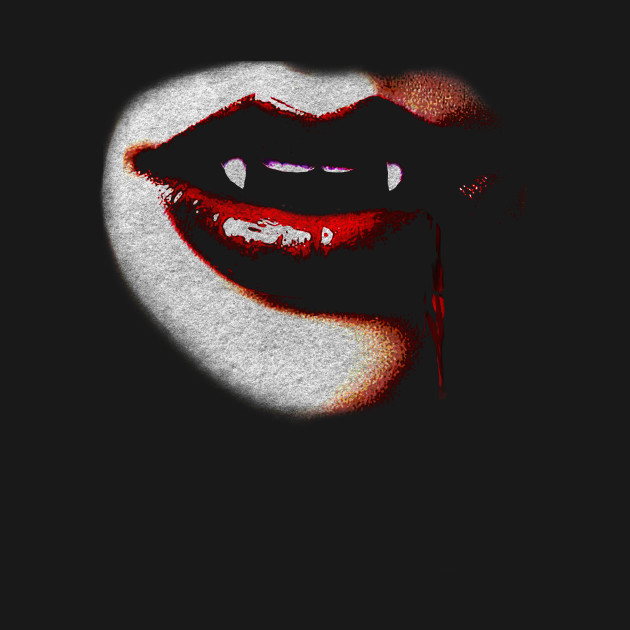
There's More to that Mouth By: Isabella Hess


There's More to that Mouth
By Isabella Hess

Image result for vampire mouth

Bram Stoker’s Dracula features different portrayals of men and woman from the idea of the new woman that can be seen in Lucy’s sexual awakening, to a more traditional idea of masculinity with the group of men constantly feeling the need to protect the women around them and shelter them from the dangers of the world.  Like Lucy, the three female vampires that live within the walls of Dracula’s castle also represent an expression of sexuality in women, but because they are vampires they are seen as evil temptresses, luring Johnathan in. He describes his feelings as “uneasy, some longing and at the same time some deadly fear” (42). I think the fear he has is due to their sexual advancement of him, when normally the man should be the one making the move and women should be the one in waiting. Another importance given to these women has to do with their teeth and their mouths. Stoker places a fixation on the physical appearance of the vampires “voluptuous lips” and their teeth that “shone like pearls” as well as other aspects of their body because women’s bodies are more important than any substance they have at this point (42). When I first read this chapter, I didn’t think about the importance of the mouths of these vampires and how it could be read to mean something different, but the more we’ve talked about it the more I see it’s sexual implications. Stoker uses “scarlet”, “ruby”, “softness, as well as many others to describe the lips of these women, but if you read into it, lips could also be read as if he was talking about a vagina. In contrast, words like “hard” and “sharp” are used to describe the teeth of the women which are used to penetrate the skin of individuals, this similarly could be read as phallic and the teeth being representative of a penis (42-43). Being opened to this different interpretation, I remembered our talk about Oscar Wilde and how he was put on trial for being gay and in engaging in romantic and sexual relationships with men. This made me wonder about how the portrayal of the female vampire’s penetrative teeth played into that and if maybe they were desired and feared because they represented, at least with Johnathan, this homosexual attraction, but also this knowledge that it could lead to problems because it wasn’t behavior that was praised within the society. Dracula’s vampire brides can be categorized as new women able to express their sexuality, but I argue that they can also represent the fear that surrounded the idea of homosexuality around that time. Dracula has a particular interest in the different ways the women expressing their sexuality are seen, especially when looking at how human women are looked at and how vampire women are seen. The vampire brides are alluring, but feared, and the human females are sick and in need of change. A major difference that can be seen between the two portrayals of the women in the novel ultimately comes down to their mouths, and the representations that go with them. 

Reference
Stoker, B. (2012). Dracula. New York, NY: Sterling Publishing Co., Inc

Tuesday, April 9, 2019

Mina vs Lucy - Angel of the House vs the New Woman

Throughout the novel Dracula women, more specifically Lucy and Mina, are portrayed in contrasting ways in order to represent two extremes in regards to Victorian Women: the “Angel in the House” and the “New Woman”.


Angel in the House
The New Woman
Women are expected to join in a monogamous relationship and have children. Mina demonstrates this ideal by marrying Jonathan Harker and later having his child. As mentioned in the last chapter, “It is an added joy to Mina and to me that our boy’s birthday is the same day as that on which Quincey Morris died,” (326). Mina fulfils her role as a woman not only by having a mutually exclusive relationship with him through marriage, but also by bearing him a child, a son no less.
Lucy never formally gets married before she dies and has trouble choosing a man to marry. She writes to Mina telling her of her three proposals (57) and whines, asking, “why can’t they let a girl marry three men or as many as want her and save all this trouble,” (60). Lucy mentions little about any plans to have children and the only interaction with children that she has in the novel is when she becomes a vampire and feeds off children. As the novel states, “During the past two or three days several cases have occurred of young children straying from home or neglecting to return from their playing on the Heath. In all these cases the children were too young to give any properly intelligible account of themselves, but the consensus of their excuses is that they had been with a ‘bloofer lady’, (159). Instead of having children of her own Lucy begins to prey on children, draining the life of them instead of bringing life to them.

In both ways Lucy represents a direct contrast to Mina as not only does she not want to settle down with just one man and have his children, but she wants to marry more than one man and shows no apparent interest in having children. In fact, she hurts children instead of having them.
The Angel of the House of the ideal woman also spends her time exclusively in the domestic sphere. Once she is married Mina is almost always at Jonathan’s side, bound to follow him except when he and the other men go, in which case she is left alone. The one time Mina leaves the home is when she is chasing after Lucy, which she wants to keep quiet, because she writes, “not a soul did I see; I rejoiced that it was so, for I wanted no witness of Lucy’s condition” (88). This could refer to Lucy sleepwalking, or the fact that she is walking around at night in just a nightgown and without any shoes. The shock is not only that Lucy is barely dressed and sleepwalking, but also that she is out of the house and barefoot, likely to get herself into trouble.

Mina does as she is supposed to and looks after her friend, only leaving the house in an extreme case, and all the while worried about the virtue and safety of her female friend Lucy.
Lucy is a lot more likely to leave the house than Mina and does so on her own quite often, even if she is sleepwalking. As mentioned in the column to the left, one night Lucy, sleepwalking, leaves the house, the domestic sphere.

Although Lucy is unable to control her trips outside, she still leaves the home and in conditions that would have been shocking to any passerby and no doubt shameful, hence why Mina worries that someone will see her friend in such a state.

- Courtney Sellars

Sookie's Real Disability

Sookie's Real Disability Sookie Stackhouse calling her superpower a disability is universally annoying and self-pitying, but what de...